
Could Universal Basic Income End Extreme Poverty?
Millions of people around the world struggle with extreme poverty, which is not having enough money for essential needs such as food, clean water, healthcare, and a safe place to live.
For many years, leaders and thinkers have searched for a real solution to this problem. One idea that keeps coming back is the concept of a universal basic income, also known as UBI. It is an idea that is currently being discussed more than ever, especially due to the efforts of people like Rutger Bregman.
What is universal basic income exactly? Could it actually end extreme poverty? Let’s explore this idea in simple terms.
What Is a Universal Basic Income?
A universal basic income is a minimum amount of money that helps meet basic human needs, based on each country’s economy. No matter where they live or what they do, every person on Earth should receive this fixed amount of money on a regular basis, for example, every month. This money does not depend on a person’s job, income, background, or social status. It would be given freely, just because someone is a human being.
This idea is closely connected to another concept called global basic income, which is usually discussed at the international level. A universal basic income program gives money to every citizen of a single country, and it is usually a more common expression. Global basic income takes this same idea and applies it to the entire world, not just one nation. While UBI is typically discussed within the framework of a single nation, global basic income represents it worldwide.
In this article, we focus on UBI as a more actionable concept.
What Is Rutger Bregman’s Idea of UBI?
Rutger Bregman is a Dutch historian and author, and he is one of the best-known advocates of universal basic income. In his book “Utopia for Realists,” he argues that giving people cash directly, without conditions, is a smart and simple way to fight poverty.
Bregman also believes that poor people are not the problem. The main problem lies in the system itself. Instead of complicated aid programs, he thinks the simplest solution is often the best one: just give people money and trust them to use it well.
Bregman does not stop there. He is also famous for standing in front of some of the world’s richest and telling them directly that they need to pay more taxes. For him, taxes matter more than charity.
At Human Act, this is exactly where our focus lies. We agree that universal basic income is a good and humane idea that can genuinely help families. But we see wealth tax as something that lasts much longer and keeps working for generations. It can also fund UBI as a sustainable financial source.
Real long-term change comes from fixing how wealth is distributed in the first place. After that, we can decide where to allocate this capital, and UBI could be one of the best options.
Why UBI Could Be a Solution to Poverty
The main goal of a universal basic income is simple: to fight extreme poverty directly. Instead of complicated aid programs, food banks, loans, charity donations, or government subsidies, people would simply receive cash. People who received regular payments were able to:
- Start small businesses
- Buy better and healthier food
- Send their children to school
- Repair or improve their homes
- Save small amounts of money for emergencies
Give Directly reports from small basic income projects in countries like Kenya have shown some positive results. For example, Magline Awino Ndiwa, a farmer in western Kenya, used to struggle every month choosing between school fees, food, or fixing her leaking mud-thatched home. After receiving cash from Give Directly, she built a sturdier house for her five children that did not leak and had room for everyone.
These small experiments give hope that a larger program focused on ending extreme poverty could work on a bigger scale. People have the ability to make decisions and prioritize their needs. Therefore, an external agent is not always needed to make decisions for them.
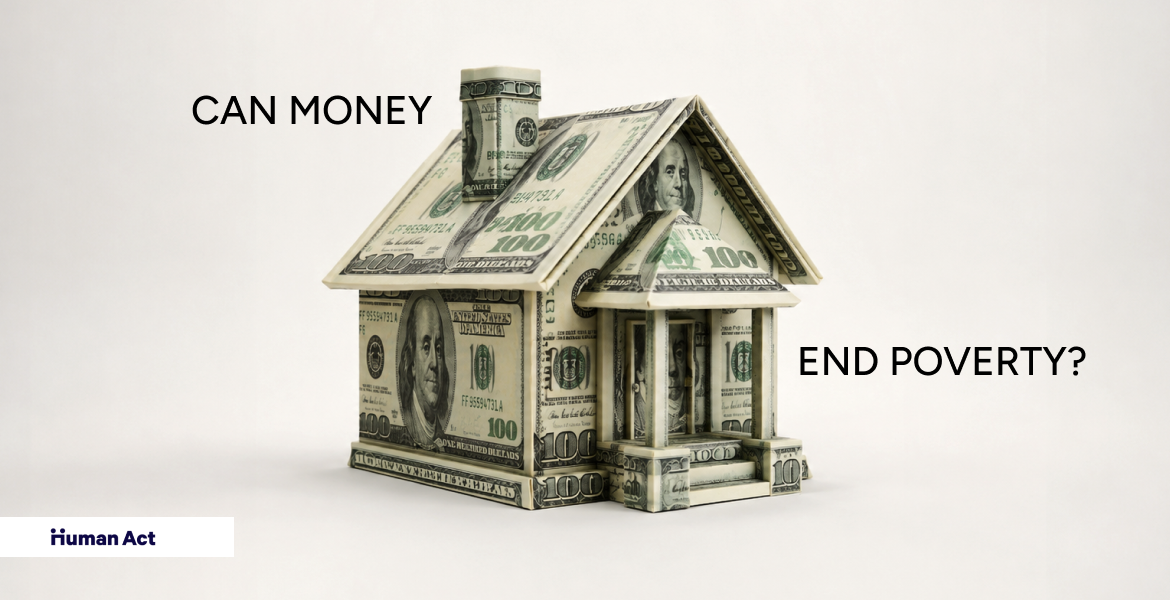
Fundamental Principles of Ending Extreme Poverty with UBI
One strong argument for ending extreme poverty with a universal basic income is trust. Instead of governments or organizations deciding what poor families need, the families themselves decide. This freedom of choice is seen as respectful and effective, for example:
- A mother might use the money for medicine
- A father might use it to fix a roof
- A student might use it for books
- A young worker might use it to start a small business
Another argument is speed. Traditional aid programs can take a long time to plan and deliver. A direct cash payment, especially with mobile banking technology, can reach people almost instantly. In today’s world, many people, even in remote villages, have access to mobile phones. This makes a universal basic income more realistic than it would have been twenty years ago.
When people have no income, they cannot plan for the future. A steady basic income could change this by putting people’s minds at ease regarding basic needs and leading them to consider greater concerns.
The Challenges & Doubts about UBI
Of course, not everyone agrees that a universal basic income is the right answer. Let’s review the main ones.
1. Cost & Funding
Giving money to every person in the world would require an enormous amount of funding. Where would this money come from? Some suggest taxing wealthy nations or big corporations, but robust structures for this idea do not yet exist.
2. Currency Devaluation & Inflation
If everyone suddenly has more cash, prices for goods like food and housing might rise. This could reduce the real value of the basic income, especially in poor communities where prices could increase quickly.
3. Management & Effectiveness
Who would organize and monitor a universal basic income? Would it be run by the United Nations, by individual governments, or by international banks? The next issue is its effectiveness. How do we know the money has reached everyone, and how do we measure its impact?
4. Financial Corruption
Mismanagement could reduce the effectiveness of the program, especially in regions with weak institutions. Some countries will never achieve financial transparency in this sector, and holding them accountable is impossible. This situation fosters an environment ripe for financial corruption.
5. Deeper Structural Problems
Some economists argue that cash alone cannot solve every problem linked to extreme poverty. Poverty is a mixture of poor structures, lack of schools, weak healthcare systems, and ongoing conflict. UBI might help individuals, but it may not fix these bigger structural problems on its own.
Could UBI Actually Work in the Real World?
The truth is, a universal basic income is still mostly a theory. It has never been officially tested on countries. Small pilot programs, like those in Kenya, Finland, Namibia, and parts of the United States, offer useful lessons, but they are way far from a fully legal system.
According to The Journalist’s Resource, some version of a universal basic income, even if not fully global, could reduce extreme poverty significantly. It might work best as one tool combined with structural reforms and infrastructure investment, for example, providing better education, stronger healthcare, and safer housing.
Our Final Thoughts on UBI
A universal basic income offers a simple and direct way to support people in need and has shown positive results in small trials. However, real-world challenges like funding, inflation, fair management, and corruption remain serious obstacles, which makes the idea difficult to implement.
A universal basic income could be a powerful piece of a bigger plan to fight extreme poverty, but the idea is bold, and the road ahead is long. However, we cannot deny that UBI offers something valuable for millions of struggling people: Hope for a future where meeting basic needs does not shape the entire story of their lives.