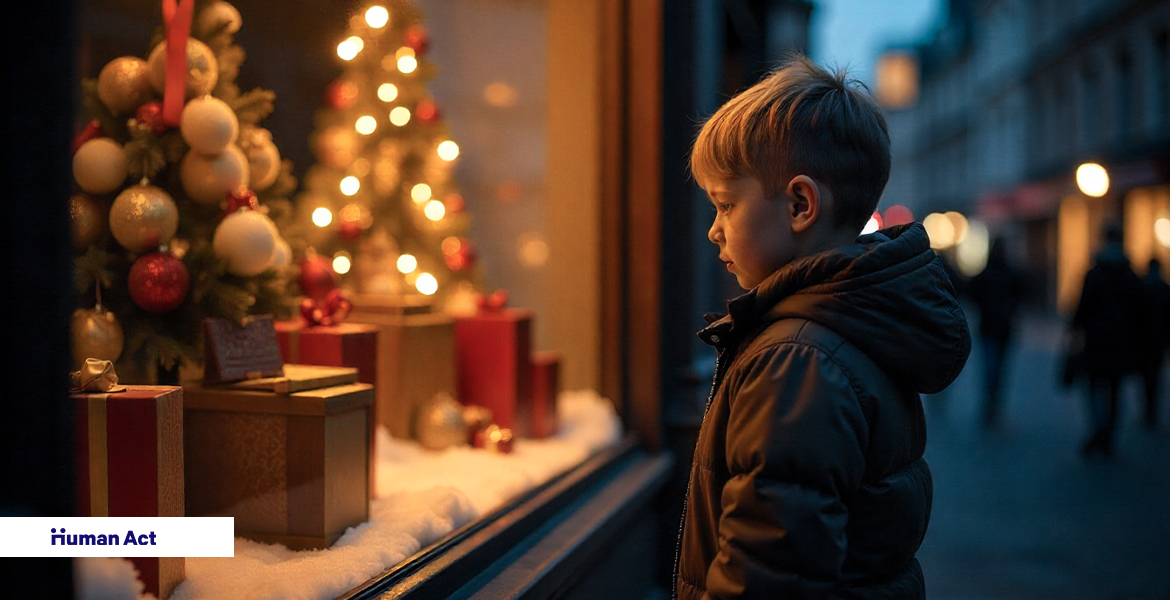
Christmas and New Year are widely imagined as seasons of warmth, generosity, and abundance. Streets glow with lights, shop windows sparkle with excess, and advertisements promise joy and happiness wrapped in ribbon and bows. And you think to yourself, this is the most wonderful time of the year!
Yet for millions of people, these holidays are not a celebration but a confrontation. A confrontation with what they lack, what they cannot provide, and how visible inequality becomes when society insists that joy should be universal. This is where seasonal poverty reveals itself.
Seasonal poverty is not a separate form of deprivation. It is the moment when existing economic hardship becomes unavoidable. Holidays magnify inequality in many ways. Costs rise, expectations intensify, and social comparison becomes relentless. For families already living on the edge, Christmas and New Year are not emotionally neutral events, they are pressure points.
Modern Christmas is not merely cultural, it is commercial. It demands participation. Gifts, festive meals, decorations, travel, school activities, social obligations, all of these carry costs. While middle and upper-income households may experience this as indulgence or even excess, low-income families experience it as exclusion.
Children feel this situation most sharply. The holiday narrative teaches them that gifts are rewards, that goodness is measured by abundance, and that joy is something everyone else seems to receive automatically. When they do not, they learn early that some joys are unevenly distributed.
Seasonal poverty cannot be reduced to a lack of financial resources alone. It also involves the social and psychological consequences that emerge during highly visible periods of consumption. Feelings of shame, heightened exposure to comparison, and a weakened sense of belonging often accompany economic hardship at these times. What is presented publicly as a shared celebration can, for some, becomes a quiet experience of exclusion.
One of the most persistent myths surrounding poverty is that it exists “elsewhere.” Yet in some of the wealthiest nations in the world, child poverty rates are rising.
In the UK, Australia, Europe, and North America, food banks report their highest demand during the holiday season. Families skip meals, so children can eat. Parents delay heating their homes to afford a small gift. Many children wake up on Christmas morning with little or nothing to open.
This is not the result of individual failure. It is the outcome of structural inequality: stagnant wages, rising housing costs, insufficient social protection, and policy decisions that prioritize markets over people.
Seasonal poverty simply exposes what exists all year long.
Children are uniquely vulnerable to seasonal poverty because they understand more than adults often assume. Research consistently shows that children living in poverty are aware of their circumstances. They know the difference between wants and needs. They know when their family cannot afford something. And they know when they are being left out.
From a child’s perspective, poverty means:
During holidays, these experiences intensify. The contrast between “what should be” and “what is” becomes unavoidable. Over time, this damages mental health, self-worth, and a child’s sense of future possibility.
Few holiday myths are as deeply embedded as the idea that children are rewarded for good behavior. “Naughty or nice” is presented as harmless tradition, yet it carries a troubling implication: that material reward is linked to moral worth.
For children living in poverty, this narrative can become cruel. When gifts do not arrive, when celebrations fall flat, the unspoken question lingers: Was I not good enough? This is not a failure of imagination. It is a failure of social storytelling.
Poverty is not a moral outcome. It is a political and economic condition shaped by decisions about wages, welfare, taxation, and public services. No child belongs on a “naughty list” because their parents cannot afford Christmas.
During the holidays, charitable giving increases. Food drives, toy collections, and emergency relief programs become more visible. These efforts matter. For many families, they are the difference between survival and collapse.
But charity, when treated as a permanent substitute for policy, becomes part of the problem.
Seasonal charity can unintentionally normalize poverty, framing it as an unfortunate but inevitable condition that must be softened rather than eliminated. It allows governments to step back while communities step in, year after year, crisis after crisis.
Real change requires more than generosity. It requires accountability.
Seasonal poverty is not simply a matter of temporary hardship dictated by the calendar. It is a reflection of permanent inequality that exists all year long. The heightened visibility of consumption and social rituals during holidays like Christmas and New Year does not create poverty, but it exposes the gaps and failures that have long persisted in society.
When a family struggles to put food on the table in December, it is not because the month itself is harsh, but because stagnant wages, rising living costs, and inadequate social support systems have left them vulnerable for months, even years. When a child feels excluded from celebrations, when they see peers receiving gifts or participating in activities they cannot afford, it is a stark reminder that structural inequities have already shaped their everyday reality.
The holiday season merely magnifies these disparities, turning what is usually private and hidden into something highly visible, and offering a lens through which we can see just how persistent and systemic inequality truly is.
Holidays are meant to be collective experiences. They are supposed to bind societies together through shared meaning. But when celebration depends on consumption, joy becomes exclusionary.
Perhaps the question is not how to make Christmas cheaper for the poor, but how to redefine what celebration means in unequal societies.
Seasonal poverty forces us to confront an uncomfortable truth: joy is unevenly distributed, and inequality becomes most visible when society insists everyone should be happy at the same time.
Behind the lights and music are children learning early lessons about scarcity, silence, and self-blame. They carry these lessons long after the decorations come down.
If poverty is a policy choice, as many economists and social researchers argue, then ending child poverty is also a choice. Seasonal poverty is not an accident. It is a signal, one we ignore at the cost of another generation.
Poverty during the festive season is a reminder of inequality that does not vanish, even under lights and music.
Family Action / Save The Children / Australia Institute
"*" indicates required fields

ActionAid Denmark is a movement that fights for a more just and sustainable world. Supporting youths in developing their voice and applying pressure on those in power.

Stay Informed and Inspired!
"*" indicates required fields
Embrace our newsletter to unite behind traditional philanthropy and champion wealth taxation. Get exclusive insights, impactful stories, and policy updates. Join us in reshaping a fairer future. Subscribe now!