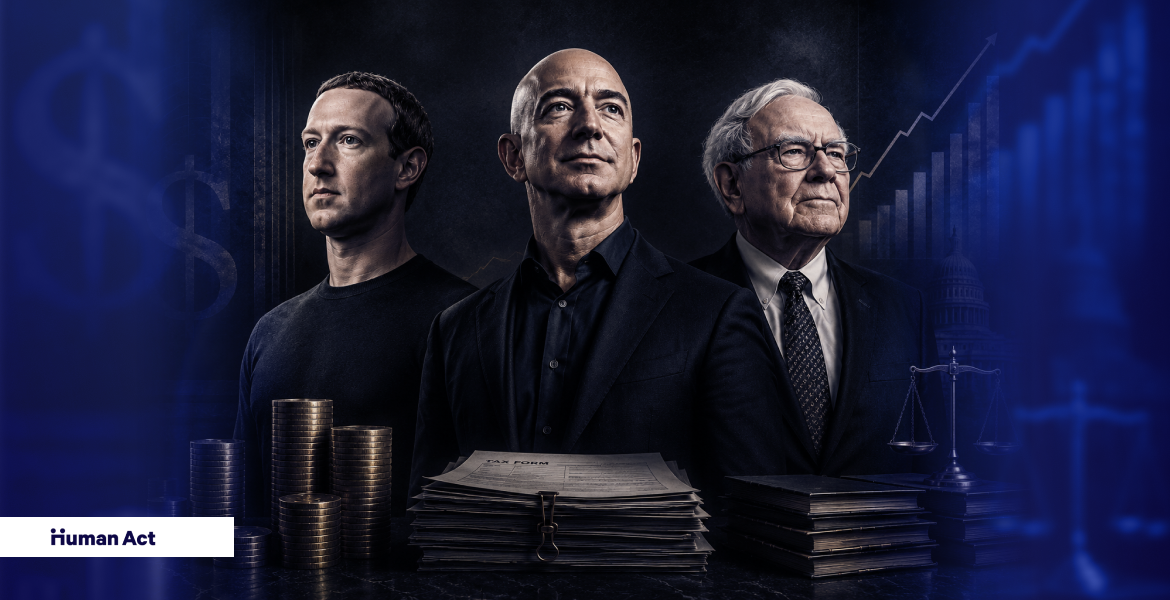
How Much Tax Do the Super-Rich Really Pay?
If you ask most people whether the super-rich pay their fair share of tax, they will probably say no.
It is one thing to have a hunch and another to see the actual numbers. Once you do, the picture is more shocking than most people expect, and it explains why tax fairness has become one of the biggest economic debates in the world today.
Let’s take a look at real numbers in this article.
The Super-Rich Only Paid 3.4% Effective Tax Rate!
In 2021, the ProPublica journal got secret tax records from the U.S. government. These records showed how much tax famous names of the super-rich pay, like Warren Buffett, Jeff Bezos, and Elon Musk.
The results were shocking. Some of the super-rich people in America pay no federal income tax in some years. And often, they pay a lower tax rate on their money than normal workers pay on their wages.
Here is one clear example of how the super-rich operate. Between 2014 and 2018, the 25 richest people in the U.S. became $401 billion richer. During that same time, they paid only $13.6 billion in federal income tax. If you do the math, that is a tax rate of just 3.4% on how much richer they became.
Some single examples are even more extreme:
- Warren Buffett’s wealth grew by $24.3 billion between 2014 and 2018. He paid about $23.7 million in tax. That is a tax rate of only about 0.1%.
- Jeff Bezos’s wealth grew by $127 billion between 2006 and 2018. He paid $1.1 billion in tax. That is a tax rate of about 1.1%.
Effective Tax Rate vs. Official Tax Rate: Why the Numbers Differ
This is where it gets confusing. If you only look at the money the super-rich officially report as “income” (like salary or dividends), the numbers look better. One study found a group of top billionaires paid an average tax rate of about 18.2% on this reported income.
But this number hides the real story. Most of the super-rich do not get rich from a normal paycheck. They get rich because the value of things they own goes up, like company stock, real estate, or a business. As long as they do not sell these things, the law does not count this growth as income. So it is never taxed.
When experts included this hidden wealth growth, the tax rate for a group of top billionaires dropped to just 4.8%. Experts now call this a person’s true tax rate, also known as effective tax rate, the real percentage of new wealth that actually gets taxed.
This is not really a trick or a loophole. It is simply how tax law defines income. A teacher or nurse pays taxes the moment they get paid. But a billionaire whose company stock doubles in value pays nothing on that gain unless they sell it. And even then, they usually pay a lower tax rate than workers pay on wages.
We Need a Fair Tax System!
Income tax in the U.S. is supposed to work like this: the more money you make, the higher percentage of tax you pay. This is true for most people. ProPublica tax data shows that the effective tax rate goes up as income goes up, all the way up to about $2–5 million per year. At that level, people pay an average effective tax rate of about 27.5%, the highest of any group.
But after that point, something strange happens. The tax rate starts going down again for the super-rich who earn even more because they have tools that most people do not have:
- hold on to stock instead of selling it.
- borrow money using their stock as a guarantee, instead of cashing it in.
- give large stock donations to charity, which lowers their taxable income and avoids extra tax at the same time.
So instead of tax rates going up and up forever, they rise, then fall again, right at the very top, where the super-rich live. This is the center of the tax fairness problem. The system says it is fair to everyone, but in real life, it is easier on the richest people than on the middle class.
Why the Effective Tax Rate Is Still Not Enough for Tax Fairness
This problem is not only in America. French economist Gabriel Zucman studied this for the G20 group of nations. He found that the super-rich around the world pay an average effective tax rate of only about 0.3% of their total wealth each year. And this rate has been getting smaller for many years, even as billionaires get much richer.
This pattern is not limited to the United States. Similar trends appear around the world. Oxfam reports that the richest 1% of people in the world gained trillions of dollars in new wealth over the last ten years. This is far more than the wealth gained by the poorest half of the entire world, combined.
When the richest people pay a smaller share of their wealth in tax, governments have less money for schools, hospitals, roads, and other public services. Someone has to make up the difference, usually regular taxpayers, through higher taxes or fewer public services. Some experts also say that when wealth is this concentrated, it can give a small group of people too much power over politics and society.
What Is Being Done About Tax Fairness?
In 2024, as G20 finance ministers met in Rio de Janeiro, Gabriel Zucman came up with an idea that many people once thought would never happen. His idea was simple. Anyone worth more than about $1 billion would have to pay at least 2% of their wealth in tax each year. If they already paid that much through the normal tax system, they would not have to pay anything extra.
Zucman says this could raise about $200 to $250 billion every year from around 3,000 of the super-rich. Not everyone liked the idea. Brazil, France, Spain, and South Africa supported it. The United States said NO, and Germany was also not convinced.
Some wealthy people started saying that people like them should actually pay more tax. One example is the Millionaires for Humanity campaign, a group of wealthy people who believe billionaires and millionaires should pay more tax. It is not something you hear every day. Some of the richest people in the world are asking governments to tax them more.
Hopefully, this idea is starting to spread. In the United States, for example, Elizabeth Warren, Pramila Jayapal, and Brendan Boyle have introduced the “Ultra-Millionaire Tax Act.” The proposal is expected to raise about $6.2 trillion over the next ten years.
Whether these plans succeed or not, one thing is already clear. The idea of taxing billionaire wealth is no longer just a dream or a small political idea. It has become a serious discussion around the world.
Who Wins the Super-Rich vs. Tax Fairness Battle?
The super-rich do pay some tax. But when you compare what they pay to how much richer they get every year, the real effective tax rate is much smaller than what most working people pay. This gap is the true problem behind tax fairness.
The question is not whether billionaires pay any tax at all. The question is whether the amount they pay truly matches how much wealthier they become. Until tax systems find a way to tax this hidden wealth growth, not just wages and sales, this gap will likely continue, no matter how rich the world’s richest people get.
Sources
Gabriel Zucman’s Proposal for the Brazilian G20 Presidency / Oxfam / Tax Decode