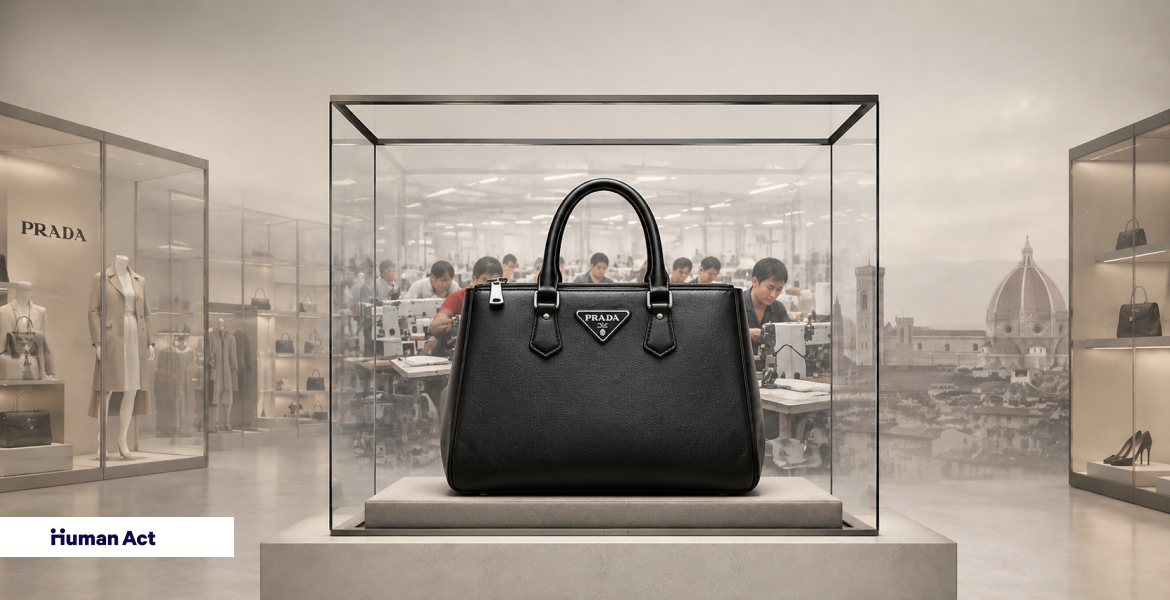
The Secret Behind Luxury Fashion Manufacturing & Supply Chain
As one former industry insider once said, in some cases, the only part that’s truly ‘Made in Italy’ is the box!
When a big global luxury fashion brand wants to advertise a new product, they make ads that cost a lot of money. They show it in a way to look like the masterpiece of the century, something that will almost never be made again.
They choose very famous people as “brand ambassadors” so the product gets seen as much as possible. If you visit their store, you will probably see that they have placed the product on a soft cushion, under beautiful lights. Its price is a few hundred thousand dollars, and everyone dreams of owning it in their heart.
What if we told you they are just selling you an illusion? Let’s discover the reality.
Luxury Manufacturing: The Small Workshop Myth
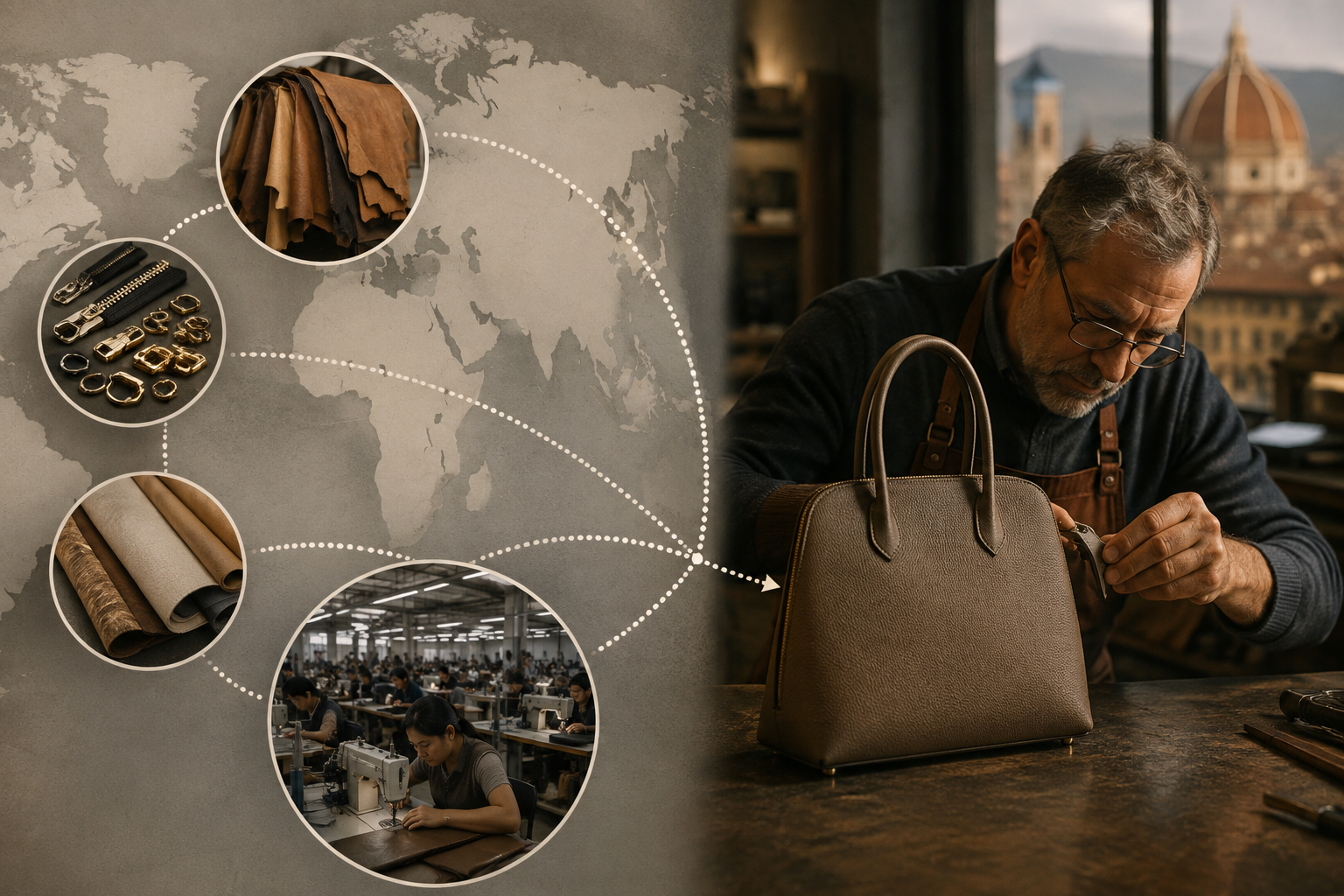
Expensive luxury fashion brands tend to show pictures of a small workshop, maybe in a country like Italy or France, with a worker sitting at a table and making a bag by hand with love and joy!
This image makes people look at the brand emotionally and trust it easily. But in fact, the product passes through several countries and several workers before reaching the main store. This is the fashion supply chain the brand never shows you.
The real luxury manufacturing process is much bigger and wider. For example, a handbag is often made like this:
- The leather is tanned in one country.
- The zippers and metal parts are made in another country.
- The fabric inside the bag is woven somewhere else.
- Most of the cutting and sewing is done in a country where worker wages are very low.
- Only the last step, which is often very small, is done in the “famous” country!
This is what a real fashion supply chain looks like. The last step usually just means attaching the zipper or adding a few metal rivets. This one small step, known as “finishing,” is enough for the label to say “Made in Italy” or “Made in France.”
Why the Last Step Matters in Luxury Manufacturing
The rule is simple and a bit strange: in most countries, a product can carry a country’s name if only the last minor change happens there. It does not matter where the rest of the work was done. So here is what actually happens in the fashion supply chain:
- About 90% of the real luxury manufacturing work, like cutting, sewing, and making the bag, is done in a country with cheap labor.
- Only the last small part is done in the country whose name goes on the label.
- The customer never sees the path it traveled. They only see the final label and the final price!
And the final price is usually ten times more than it should be. You are not just paying for materials and skill. You are paying for the story they tell you and for the name on the label.
What Is the Luxury Fashion “Made in” Loophole?
The law governing luxury fashion labeling in most places, including the European Union, says a product can carry a country’s name if the last small step happens there. It does not check how much work was actually done there, so companies deliberately use this rule, known as the “made in” loophole.
Luxury bags and shoes are made almost entirely in Asian factories (mostly China) as part of a global fashion supply chain, with only a final touch in Europe so the product can carry a European luxury fashion label. None of this breaks the law. It just uses the law in a way the law was not really originally made for!
The Real Math Behind the Price Tag
The fashion supply chain explains only part of the price gap. Where does the rest of the money go? Shipping is part of it, but only a small one. Most of the gap comes from other things.
-
The Brand Story
A big part of the price is paid for advertising, fancy stores on expensive streets, celebrities, brand ambassadors, and fashion shows, not for the leather or thread.
-
Store Profit Margin
Luxury fashion brands usually set the price at 10 times the production cost, or more. This is a planned business strategy, not an accident.
-
Fake Scarcity
Even when a brand makes thousands of copies of a bag, it still tries to make you feel like it is rare and special. That feeling is part of what you are paying for.
-
Paying for the Name
In the end, a big part of the price is not for the object itself. It is for the feeling of having that name, the label, and the brand narrative.
So, the small extra cost of shipping and finishing a product in Europe can not explain a price gap of a thousand dollars or more. That big gap mostly comes from marketing, store profit, and the brand value, not the real cost of luxury manufacturing.
Luxury Fashion Labels: A Scandal No One Talks About
The Fashion Law reported that in 2017, a small eyewear shop called Selima Optique sued Kering, the luxury giant behind Gucci, Balenciaga, and Saint Laurent. The claim was that glasses labeled “Made in Italy” were actually made entirely in China, with only final assembly and packaging done in Italy. Kering never admitted this, but the case was settled quietly out of court.
That was just the start. In 2025-2026, Milan prosecutors launched a much bigger investigation, inspecting workshops supplying 13 luxury brands, including Gucci, Prada, Versace, Dior, and Giorgio Armani.
They found Chinese workers living in near-slavery conditions with serious safety violations, sleeping inside the same workshops where they made luxury goods. Several factories tied to Dior and Armani were placed under judicial supervision, which means courts no longer trust these brands to police their own supply chains.
Inequality in the Fashion Supply Chain
Out of every $1000 you pay for a bag, maybe only $20 to $50 reaches the worker who did most of the real work. The rest goes to the brand, the store, advertising, and shareholders. Inside the fashion supply chain, the real value is created in a poorer country, but the profit is collected in a richer country.
Why This Fashion Supply Chain Cycle Never Breaks
Countries that export their cheap labor for production usually stay stuck in the same low spot on the value chain. Because the profitable parts and final selling never move to that country. Therefore, that country’s economy cannot grow and get out of the “cheap producer” role.
When demand for fast, cheap production is high, the pressure on workers gets intense. Longer working hours, lower payment, and less safe working conditions. This pattern is not only in luxury brands. It is the same in fast fashion too.
The customer is also unknowingly part of this cycle. Someone in a rich country who buys the bag thinks they are paying for “European quality,” but that extra money mostly goes into the brand’s pocket, not to the worker who actually made the product. In this case, inequality is not just about the gap between one worker and one brand. It is also reproduced on a global level between rich countries and developing countries.
Good News: Things in Luxury Fashion Are Changing!
Some governments like the European Union are now asking companies to share more information about how and where products are made, including working conditions. Also, as Rawshot.ai says, 74% of Gen Z want brands to be more transparent about where their products are made, and 57% prefer to buy from brands that disclose their supply chain information.
Because of this pressure, a few brands like Prada, Cartier, and Louis Vuitton are now publishing their supplier lists. Some are trying new ways to fully track a product’s journey. Others are bringing more production back under their own control. These are good steps, but still small compared to the size of the problem.
Conclusion: Our Role in the Fashion Supply Chain
If fair wages and working conditions really matter to you, or you just want to know what you are really paying for, simply start by doing some research and asking more questions about the reality behind the brands you love and the true origins of the products you cannot wait to buy.
For years, luxury brands have been very good at showing you a complete, flawless product. Maybe the next big change in luxury fashion will be showing the whole journey, not just the last step.
Every time we spend our money consciously, we are voting for the world we want to live in. At Human Act Foundation, we always choose a just and sustainable world.