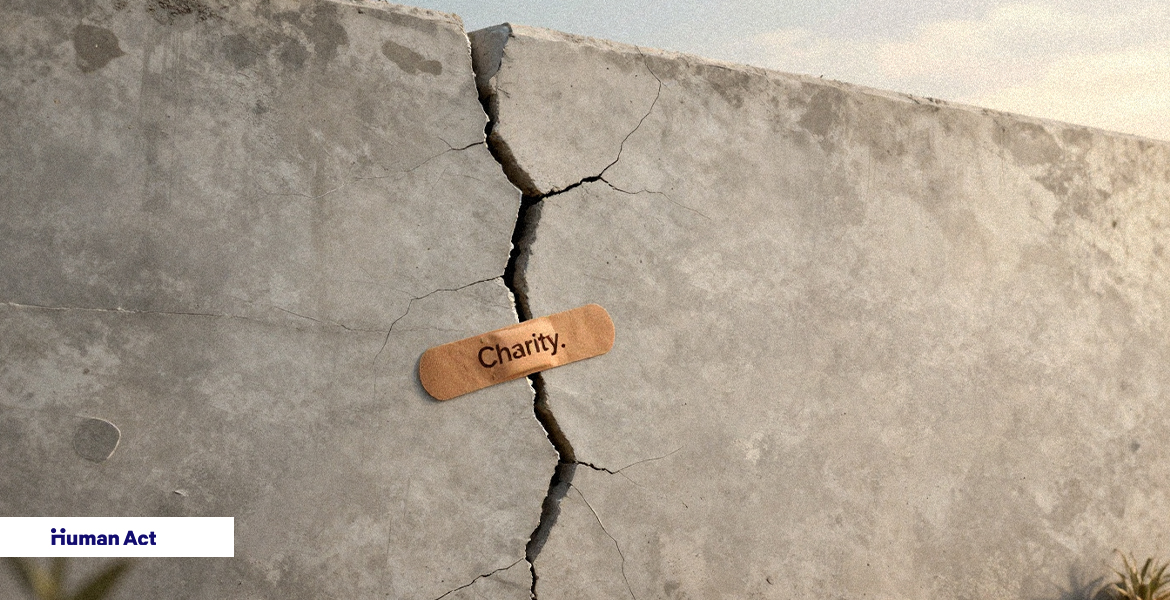
In recent years, philanthropy has increasingly been framed not as a moral commitment or a social responsibility, but as a financial strategy.
In wealth management circles, legal seminars, and private advisory meetings, charitable giving is often discussed primarily as a way to reduce tax liability. It sometimes even means a way to ensure that not a single dollar reaches the public sector.
This framing reveals something far more troubling than personal tax planning. It reflects an attempt to reimagine philanthropy as a substitute for government itself. Taxes and charity are two fundamentally different strategies, not just two different words.
Taxation is a structural mechanism. It is mandatory, law-based, and designed to redistribute wealth and fund public goods: education, healthcare, infrastructure, and social security. Taxes are not meant to be compassionate; they are meant to be fair and sustainable.
Charity is a voluntary action. It depends on choice, preference, priorities, and sometimes the moral mood of the giver. It can be valuable, but by nature it is unreliable and uneven.
The key distinction is this:
When a society lacks fair taxation, charity becomes a painkiller, not a cure. And when someone avoids taxes but gives to charity, they are bypassing justice and substituting law with personal morality.
So taxes and charity are two different strategies; one aims at justice, the other at repair. And this difference is not merely linguistic; it is political, economic, and deeply human.
Let’s answer our core question here: Can philanthropy replace taxation? And if not, why does this idea continue to be promoted so confidently?
Modern societies operate on a scale. Governments collect trillions of dollars in taxes every year to fund systems that must be universal, continuous, and reliable. This is the basic architecture of social life.
Even the largest philanthropic efforts operate on a fundamentally different scale. The most generous billionaires may give away billions over their lifetimes, an impressive and often admirable act, but billions cannot replace trillions. No private foundation, no matter how visionary, can fund nationwide school systems, public hospitals, or transportation networks indefinitely.
This is not a criticism of philanthropy; it is a recognition of reality. Charity is designed for targeted intervention and innovation, not for sustaining entire societies.
Taxation, at least in principle, is collective. Citizens contribute, and through political processes, however imperfect, they retain some degree of influence over how public resources are allocated. Philanthropy does not work that way.
In philanthropy, priorities are set by individuals with extraordinary wealth. One person decides which problems matter, which communities deserve attention, and which issues can be ignored. These decisions may be made with good intentions, but they remain unilateral and largely unaccountable.
A society cannot rely on private preferences to determine public necessities. Roads, schools, water systems, and emergency services cannot depend on what happens to interest a donor this year. Democracy cannot function when essential services are governed by personal discretion rather than collective obligation.
One of taxation’s central functions is redistribution. Progressive tax systems, at least in theory, require those with greater resources to contribute more, reducing structural inequality and funding public goods that benefit everyone.
Philanthropy does not redistribute wealth in this way. In fact, it often preserves existing power structures. Wealth remains concentrated, while decision-making authority over social priorities becomes further centralized in the hands of a few.
When billionaires define what doing good looks like, inequality does not disappear; it becomes curated. Economic power transforms into moral authority, and generosity begins to resemble governance without accountability.
Taxes are predictable. They arrive every year, allowing governments and institutions to plan long-term investments in education, healthcare, and infrastructure. Philanthropy is inherently unstable. It depends on market conditions, personal interest, reputation management, and sometimes simple boredom.
A society cannot be built on generosity alone. Schools cannot function if funding depends on donor enthusiasm. Hospitals cannot operate on the assumption that benevolence will continue indefinitely. Public systems require permanence, not goodwill.
It would be foolish to ignore the public relations dimension of philanthropy. Donations often come with naming rights, media praise, and moral rehabilitation. A well-publicized gift can reshape public perception and divert attention from labor practices, environmental damage, or political influence.
Taxes offer no such benefits. No one receives applause for paying what they owe. But the absence of recognition does not make taxation less ethical or less valuable. On the contrary, its quiet universality is precisely what makes it effective.
Helping people does not require spectacle. Responsibility does not require applause.
This is not an argument against giving. Many people donate time and money out of genuine concern for others, not because of tax incentives. Research consistently shows that tax deductions rank low among motivations for charitable giving.
Philanthropy can play an important role. It can fund innovation, support marginalized causes, respond quickly to crises, and experiment where governments cannot or will not. But it functions best as a complement to public systems, not as a replacement for them.
The danger arises when philanthropy is presented as an alternative to taxation, rather than something that operates within a framework of shared responsibility.
A healthy society requires both:
Maximizing wealth is not the same as maximizing values.
When philanthropy is used to undermine collective responsibility, it becomes just another financial instrument, empty of moral substance. But when it reflects a commitment to shared humanity within a functioning public system, it can genuinely enhance the human condition.
No one enjoys paying taxes. But a society without them is far more dangerous than any tax bill. Philanthropy can help. Taxes build societies, and confusing the two is more than foolish; it is actually profoundly dangerous.

ActionAid Denmark is a movement that fights for a more just and sustainable world. Supporting youths in developing their voice and applying pressure on those in power.

Stay Informed and Inspired!
"*" indicates required fields
Embrace our newsletter to unite behind traditional philanthropy and champion wealth taxation. Get exclusive insights, impactful stories, and policy updates. Join us in reshaping a fairer future. Subscribe now!