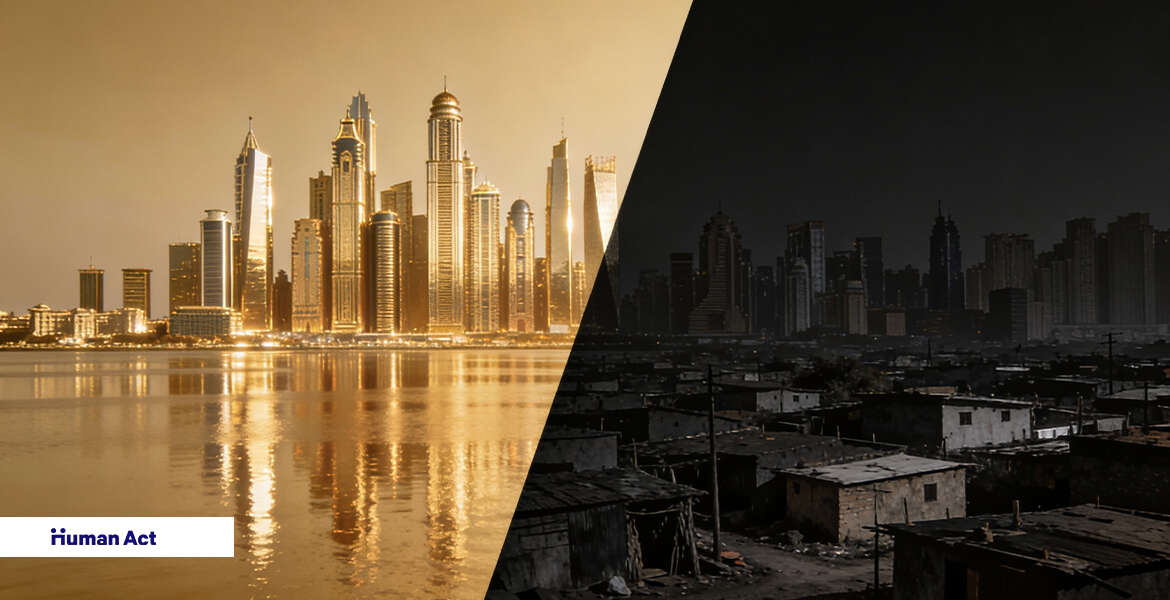
Why Does the Wealth of the Top 1% Threaten Global Stability?
A world that runs by the rich is a fragile world!
Today, a huge gap between the rich and the poor is threatening world stability. While most people struggle for basic needs, a tiny group of very wealthy people controls almost everything. This imbalance hurts democracy and weakens economies.
According to a 2024 Oxfam report, the richest 1% of the world owns more than 43% of all wealth, while the bottom 50% owns almost nothing. The wealth gained by these few people in just the last ten years could have ended global poverty many times over if it had been shared more fairly.
When so much power and money sit with a few people, societies become divided and unstable. To have a peaceful future, we must find better ways to share wealth more equally.
What Does Wealth Inequality Really Mean?
Wealth inequality, the uneven distribution of assets like money, property, investments, and savings, highlights how economic gains are increasingly concentrated in the hands of a few. While some disparity exists in all economies, extreme wealth inequality, where the rich grow richer through profits from investments or inheritance, undermines global stability.
Meanwhile, wages for ordinary workers stagnate, and rising living costs make it harder for most families to achieve financial security. This widening gap is destroying public trust and fueling despair. Therefore, adopting an optimal policy of wealth redistribution could save the world from economic collapse.
Inequality Leads to Public Anger!
Extreme wealth inequality is a major factor in the loss of global stability. When people feel that economic systems no longer reward effort or fairness, frustration builds.
Around 44% of the world’s population lives on less than $6.85 per day and struggles to afford basic necessities, while news headlines trumpet record profits and expanding billionaire wealth. This stark contrast intensifies feelings of injustice and exclusion.
As large segments of society feel trapped, social tensions rise and lead to protests and political instability. History shows that societies with extreme wealth concentration face higher risks of breakdown.
A stable society depends on a strong middle class and widespread opportunity. This makes wealth redistribution essential for maintaining social cohesion and preventing political collapse.
The Erosion of Global Stability: Wealth Redistribution vs. Elite Control
When wealth is concentrated, political influence grows, which undermins democracy. The ultra-rich can prioritize their interests, as seen with billionaires controlling over a third of the world’s largest corporations (worth over $13 trillion). This power blocks reforms needed for wealth redistribution and addressing inequality.
When political systems serve a few instead of the many, people feel disconnected from their institutions. This leads to instability, divisions, and susceptibility to authoritarian leaders.
Democracy requires accountability and participation. Extreme concentrations of money and power damage these foundations and turn systems meant to help everyone into tools for a select few. This weakening of democracy’s core poses a significant threat to peace and global stability.
How Do Unequal Economies Risk Global Stability?
When economies have a lot of differences in how much money people have, they are more likely to have money problems and big crises. If most of the money is with a few rich people, regular people don’t have enough to buy things. Rich people usually save or invest their money, instead of spending it in regular stores.
This makes people rely more on borrowing money and risky financial bets. Families borrow to keep up their lifestyle, and banks create complicated ways to invest money to try and make more profit. Over time, this can lead to unfair money growth (like bubbles) and a higher chance of the whole money system breaking down.
The big money problem in 2008 showed how these money differences and risky bets can make the whole world’s economy shaky. Many people lost their jobs, homes, money, and life opportunities. Meanwhile, the banks that helped cause the problem were saved by money from taxpayers. These kinds of events make the differences between rich and poor even worse and make long-term money worries grow.
To help prevent this and support global stability, we need better wealth redistribution. This means making sure wealth is shared more fairly so that everyone has enough to live on and contribute to the economy. This helps create a secure financial system for everyone.
Inequality in Health, Education & Human Development
Wealth inequality directly affects access to essential services. In highly unequal societies, basic needs like housing, education, food and healthcare become privileges rather than basic rights. When these disparities widen, they threaten global stability by fueling social tension and preventing sustainable development.
Low-income communities face higher disease rates, lower life expectancy, limited educational opportunities, and inadequate living conditions. Children born into poverty often remain trapped in it, as they lack access to quality schools and healthcare. This creates a cycle of disadvantage that persists across generations.
According to global data, the poorest half of humanity owns only 2% of total global wealth, while the richest 10% controls more than 75%. This massive imbalance severely restricts human development, reducing productivity, innovation, and social mobility.
Experts argue that addressing these gaps through intentional wealth redistribution is essential; when large segments of society are empowered to reach their full potential, entire economies thrive, fostering long-term growth and security.
Global Inequality & International Tensions
Wealth concentration also reinforces inequality between nations. Many developing countries provide cheap labor and natural resources for global markets, while profits flow mainly to investors in wealthier nations.
This massive imbalance contributes to poverty, political instability, conflict, and forced migration. Many policy experts suggest that more equitable wealth redistribution, both within and between nations, is a necessary step to reverse these trends.
As economic pressures increase, millions of people migrate in search of opportunity and safety, placing strain on neighboring countries and global political systems. Ultimately, rising inequality between nations continues to fuel geopolitical tension, emphasizing the urgent need for structural changes to strengthen international cooperation.
The Environmental Cost of Extreme Wealth
The world’s wealthiest individuals and corporations contribute disproportionately to environmental degradation. High-consumption lifestyles, resource-intensive industries, and large-scale pollution are closely linked to elite wealth accumulation.
At the same time, poorer communities suffer the most severe consequences of climate change, including drought, food insecurity, extreme weather events, and displacement. These communities often lack the resources needed to adapt or recover.
This environmental inequality intensifies humanitarian crises and adds another layer of instability to an already fragile global system.
The Key to Global Stability and Fair Wealth Redistribution
Reducing extreme wealth concentration is essential for economic growth, improved public health, greater social trust, and lower crime. To drive this change, we must pursue concrete actions at both national and international levels.
National Strategies
- Progressive Taxation: Implement fair tax systems and close existing loopholes.
- Economic Protections: Enforce fair wages and strengthen labor rights.
- Public Investment: Invest in universal healthcare, affordable education, and public services.
- Market Regulation: Maintain oversight of financial markets to prevent exploitation.
International Actions
- Global Cooperation: Establish international tax agreements and promote fair trade policies.
- Support Systems: Provide debt relief and climate financing to developing nations.
- Wealth Redistribution: Ultimately, equitable wealth redistribution and international cooperation are the most effective levers for ensuring long-term global stability.
Sources
Social Europe / Medium / Democracy Without Borders / Oxfam reports